

I want to speak directly to you. Have you ever found yourself sitting in a room, forgetting why you walked in? Or rereading the same sentence over and over again because your mind just won’t hold it? Have you noticed yourself feeling slower, foggier, more forgetful since your loss? If that sounds familiar, I want you to know something very important: you are not imagining it. This is often what people describe as grief brain fog. And understanding how grief affects the brain can change the way you see yourself in such situations – not with shame, but with compassion.
Grief brain fog is real
When I was grieving, I started to notice changes in my mind that scared me. I couldn’t focus. I forgot simple things. I lost my words mid-sentence. I felt like I was moving through thick fog.
I now understand this to be grief brain fog – and I want to say this clearly to you:
You are not broken.
You are not losing your mind.
You are responding to loss.

Read also ‘Navigating Grief: What It Is and How It Shapes Our Emotions‘
How grief affects the brain and creates grief brain fog
When we experience loss, it doesn’t just live in our emotions – it impacts the brain and nervous system, too. Grief asks the brain to adapt to a reality it never wanted to accept. And in many ways, the brain interprets profound loss as a threat to survival. This is why grief brain fog can feel so intense.
Different parts of the brain become affected during grief:
- The areas responsible for memory can become less efficient
- The parts of the brain linked to concentration and decision-making can feel harder to access
- The emotional centres can become more reactive
- The nervous system can stay in a heightened state of alert
When all of this is happening at once, it makes complete sense that you might experience grief brain fog, overwhelm, anxiety, or emotional exhaustion. Your brain is not failing you. It is trying to protect you while processing loss.
Why grief brain fog affects your daily life
You might notice grief brain fog in everyday ways:
- Walking into a room and forgetting why you went there
- Struggling to follow conversations
- Feeling mentally “slower” than usual
- Losing focus easily
- Feeling overwhelmed by simple decisions
And then the hardest part: judging yourself for it. But I want to gently interrupt you there. This is not a lack of strength. This is grief working its way through the brain and nervous system.
Grief brain fog, and mental health
We don’t talk enough about how deeply grief and mental health are connected. Grief can affect anxiety levels, emotional regulation, sleep, concentration, and overall mental well-being. And when grief overlaps with trauma, stress, or conditions like PTSD, grief brain fog can feel even more intense.
Your mental health is not separate from your grief – it is part of it. And what you are experiencing deserves understanding, not shame.
You are not failing – you are grieving
I want you to hear this as clearly as possible: If you are experiencing grief brain fog, you are not failing at life.
You are not doing grief “wrong.”
You are not behind.
You are grieving.
And grief is not just emotional – it is neurological, physical, and deeply human.

Read also ‘When Will My Life Go Back to Normal Again, and Does Grief Ever Go Away?‘
Mental Health Awareness Month reminder
During Mental Health Awareness Month, I want to remind you of this:
If your mind feels different after loss, that matters.
If your focus, memory, or clarity has changed, that matters.
And, if you are struggling with grief brain fog, that matters too.
You do not need to minimise your experience because others cannot see it.
A gentle invitation for you
If this resonates with you, I want to invite you into something simple today: Pause for a moment. Place your hand on your chest or your opposite arm. And remind yourself: “I am not broken. I am grieving. And my experience is real.”
Because healing begins not with forcing clarity – but with offering yourself compassion in the fog.
Final thoughts on grief brain fog
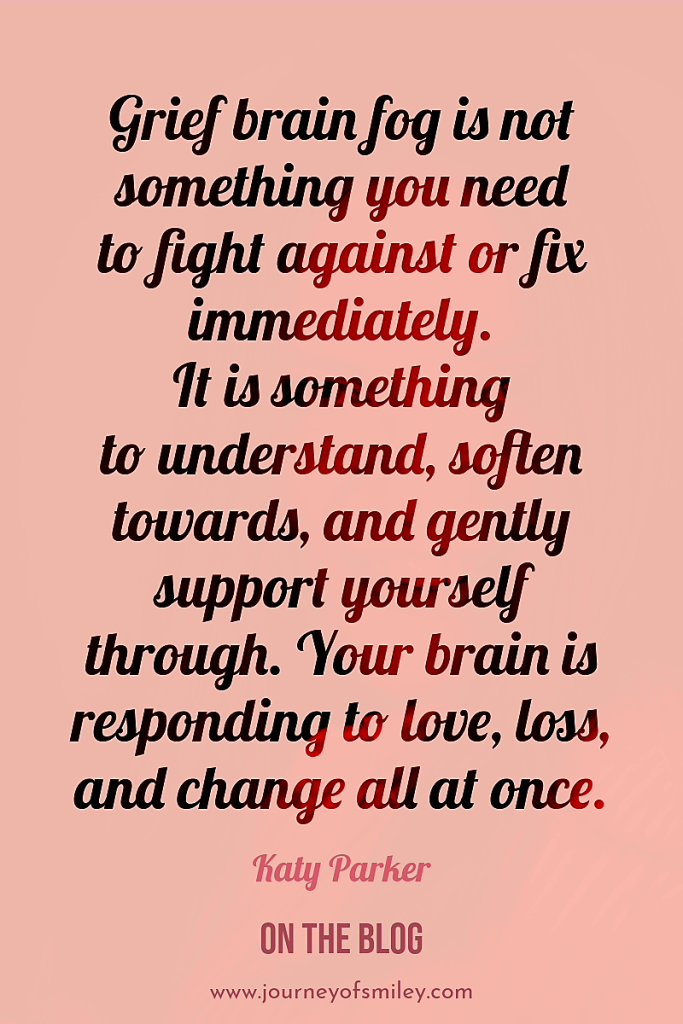
Grief brain fog is not something you need to fight against or fix immediately. It is something to understand, soften towards, and gently support yourself through. Your brain is responding to love, loss, and change all at once.
And even in the fog, you are still here.
Still trying.
Still feeling.
Still human.
If this speaks to you, I’d love to hear from you. You can share your experience or connect with me through my writing on Journeyofsmiley, where I continue to explore grief, mental health, and invisible loss.
You are not alone in this.
This reflection is inspired by themes explored in Katy Parker’s upcoming book, What If This Is Grief?, a book that explores grief in all its forms – from the death of a loved one to invisible and unrecognised losses, chronic pain, trauma, faith, and healing.
Till the next blog post,

If you like what I do, please support me on Ko-fi
