
Exploring the grief that comes after domestic abuse, the loss of identity, and the life you once imagined.
There are losses no one names. Losses that happen quietly, sometimes so gradually that you don’t realise how much has changed until you look back and struggle to recognise the person you used to be.
I believe most of us enter a relationship hoping it will last. We imagine sharing our lives with someone, building a home, growing old together, and standing beside each other through good times and bad. We don’t expect the person we love to become someone we fear. Yet, according to the Office for National Statistics (ONS), an estimated 3.8 million adults experienced domestic abuse in England and Wales in the year ending March 2025. Behind these statistics are people, relationships, families, and futures that look very different from what was once imagined.
I often think about my mum. When she entered her relationship, I don’t believe she knew she was walking into years of domestic abuse or understood the impact it would have on her children. Like many people, she had hopes of a happy family and a future built with the man she had thought would be a loving, caring husband. But sometimes, the life we imagine becomes a life we never expected to live.
When we talk about domestic abuse, we often talk about recognising the signs, finding safety, and having the courage to leave. Of course, these conversations matter. But what about the losses that remain unspoken? The grief that comes after domestic abuse – the grief of losing part of yourself, the future you imagined, or the life you hoped you would have? What if domestic abuse takes more than just the relationship?
Read also ‘PTSD and Grief: When the Body Holds Unprocessed Loss‘
The grief after domestic abuse that no one sees
My parents divorced when I was a teenager. Back then, I couldn’t understand why it had taken my mum so long to leave a relationship in which there was violence. I understood things differently when I found myself in a serious relationship where I hoped to find love. I believed I had found it, and I didn’t recognise the warning signs.
Perhaps, in some ways, what felt familiar was difficult to question. Growing up in a dysfunctional family had shaped my understanding of relationships. When certain behaviours are part of the environment we grow up in, they can become familiar, even when they are harmful. This doesn’t mean we are destined to repeat our childhood experiences, but it can make recognising unhealthy patterns more complicated.
What I thought was protection at first, gradually revealed itself as possessiveness. I remember feeling like that little girl again, back in my childhood home. I had known the freedom that came after my dad left: making decisions without fear of someone’s reaction, seeing friends without feeling anxious, and feeling more at ease in our own home. Now, I found myself grieving those freedoms all over again.
When I eventually left that relationship, my emotions were confusing. One day, I felt relief; the next, sadness. I knew the relationship wasn’t right for me, yet I had wanted it to work. There had been a hope that, somehow, things might change and the future would become the opposite of the childhood I had experienced.
You can grieve what you hoped for without wanting to return to what hurt you
I wondered whether my mum had felt similarly. Had she also struggled with the gap between the life she hoped for and the reality she was living? Had she mourned the family she wanted, even whilst trying to navigate what was happening within it?
I may never know exactly what she felt and unfortunately, I can’t ask her anymore as she is no longer with us. But I began to understand that leaving a relationship doesn’t mean leaving all the losses associated with it behind. Sometimes, we are grieving not only what happened, but also what we hoped would happen: the loving partnership, the happy family, the future we had imagined building together.
Perhaps you recognise this in your own experience. You might know that leaving was necessary and yet still feel sad about what you had hoped the relationship would become. There may be moments you miss, promises you once believed, or simply the future you thought was possible.
I also knew that, for me, leaving the relationship wasn’t the only change I needed to make. To find the freedom I longed for, I needed to leave the city where we had lived, too. Looking back, I understand that grief after domestic abuse can hold many feelings at once. Relief can sit alongside sadness. Knowing you made the right decision doesn’t mean you won’t mourn what you have lost.
There is rarely a funeral for the life we imagined, yet the loss can still be profound. And you don’t have to dismiss that grief simply because you know the relationship wasn’t right for you.
What if you are grieving the person you used to be?
One of the quieter losses associated with domestic abuse is the loss of identity. Perhaps you remember a time when you trusted your judgement, felt confident in your decisions, or expressed your opinions without hesitation. Maybe you were spontaneous, sociable, comfortable being yourself. And perhaps, somewhere along the way, things began to change. You started questioning your instincts, carefully choosing your words, or paying close attention to another person’s moods. You found yourself trying to keep the peace, avoiding conflict, or having to anticipate what might happen next.
Over time, these adjustments can change how you see yourself. You might look back and wonder where your confidence went or why decisions that once felt so simple now seem difficult. If this feels familiar, I invite you to pause and ask yourself: What do you miss about yourself?
Perhaps it’s your laughter, your independence, your friendships, or your ability to trust your own voice. Maybe you cannot quite name what’s missing, only that you no longer feel like the person you remember. There is grief in recognising these changes. But the person you became while navigating difficult circumstances is not someone you need to blame or reject. You deserve compassion for what you experienced and for the ways you tried to cope.
Read also ‘Father’s Day Grief: Grieving What Was Never Fully There‘
Healing and Grief After Domestic Abuse
Leaving an abusive relationship can be an important step towards safety, but it doesn’t necessarily bring an immediate end to your grief. Perhaps you expected to feel free, only to discover that you are exhausted. You might feel relieved one day and overwhelmed the next or find yourself wondering why the past still affects you. Healing isn’t a linear process. You don’t have to rush towards acceptance or turn everything you experienced into a lesson.
Perhaps you could begin by asking yourself:
- What have I lost that I haven’t given myself permission to grieve?
- What parts of myself do I miss?
- What do I need now that I may have previously put aside for someone else?
You don’t have to answer these questions all at once. You might write down your thoughts, talk to someone you trust, or simply allow yourself to rest. And perhaps, little by little, you will begin to recognise parts of yourself again. You might find confidence in a small decision, reconnect with someone who cares about you, or discover that you can enjoy a moment without worrying about what comes next. These moments don’t erase what happened. They simply remind us that grief and possibility can exist alongside one another.
You are more than what happened to you
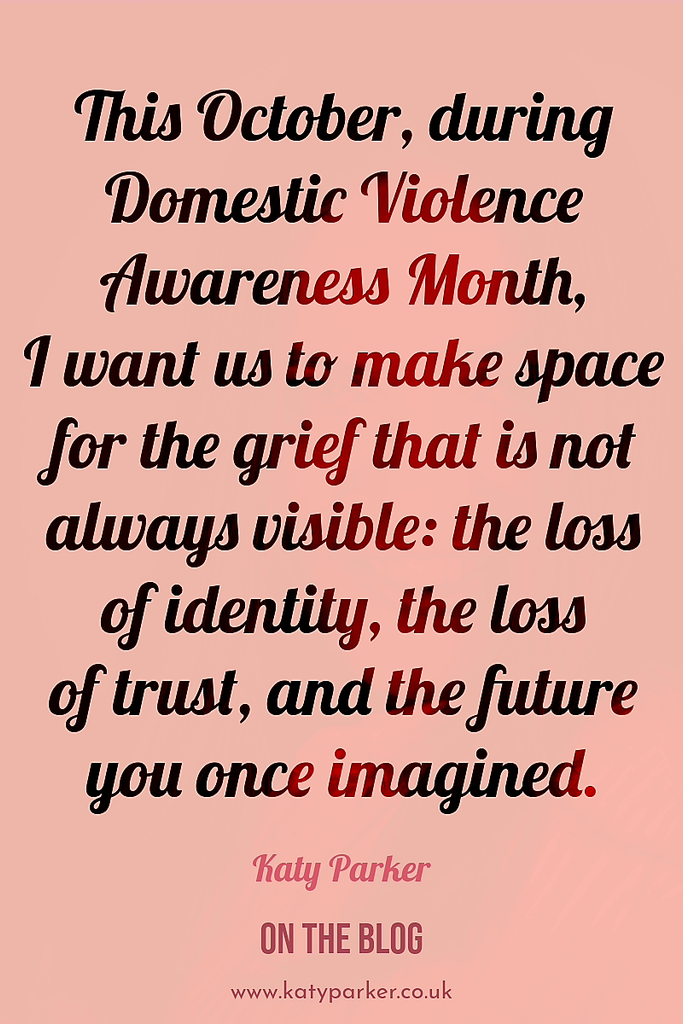
This October, during Domestic Violence Awareness Month, I want us to make space for the grief that is not always visible: the loss of identity, the loss of trust, and the future you once imagined.
If you have experienced domestic abuse, there is no need to dismiss your sadness simply because the relationship has ended. Nor do you have to hide your grief while rebuilding your life. You are allowed to mourn what should have been different. You were never only what you did to keep the peace, how much you endured, or how hard you tried to make things work. Your worth was never dependent on any of those things.
There is room to acknowledge what you have lost, and room to discover what remains. Because domestic abuse can take more than just the relationship and those losses deserve to be recognised, too. And if you are still finding your way, remember this: your life is still unfolding, even if it looks different from the one you imagined.
Read also ‘Identity Loss: What if You’re Not Lost, Just Becoming?‘
When You Need Someone to Walk Alongside You
My upcoming book, What If This Is Grief?: Finding Your Way Through Loss and Heartache, explores the many different forms loss and grief can take, including the experiences we don’t always recognise as grief. Because sometimes, what we need most is simply to understand what we are carrying and to give ourselves permission to acknowledge it.
And sometimes, you don’t need someone to tell you how to fix things. You need someone to sit with you in the uncertainty, listen without judgement, and walk alongside you as you find your way through.
If you’re carrying something that feels difficult to navigate alone, as a certified Mental Health and Grief & Loss Coach and Grief Educator, I offer coaching. If you’d like to explore whether coaching might be right for you, email me at katy@katyparker.co.uk to arrange a conversation.
You don’t have to have all the answers before you reach out. Sometimes, taking that first step simply means acknowledging that what you’re going through matters.
If you need support: In the UK, Refuge’s National Domestic Abuse Helpline is free and available 24 hours a day on 0808 2000 247. Visit nationaldahelpline.org.uk for support and information. If you are in immediate danger, call 999.
This reflection is inspired by themes explored in Katy Parker’s upcoming book, What If This Is Grief?, a book that explores grief in all its forms – from the death of a loved one to invisible and unrecognised losses, chronic pain, trauma, faith, and healing.
Till the next blog post,

If you like what I do, please support me on Ko-fi
